Dough Journal
Beginner sourdough bakers have no single resource that guides them through the full process step by step. They collect information from videos and Reddit posts that often contradict each other, track their bakes in scattered notes, and have no way to learn from one bake to the next.
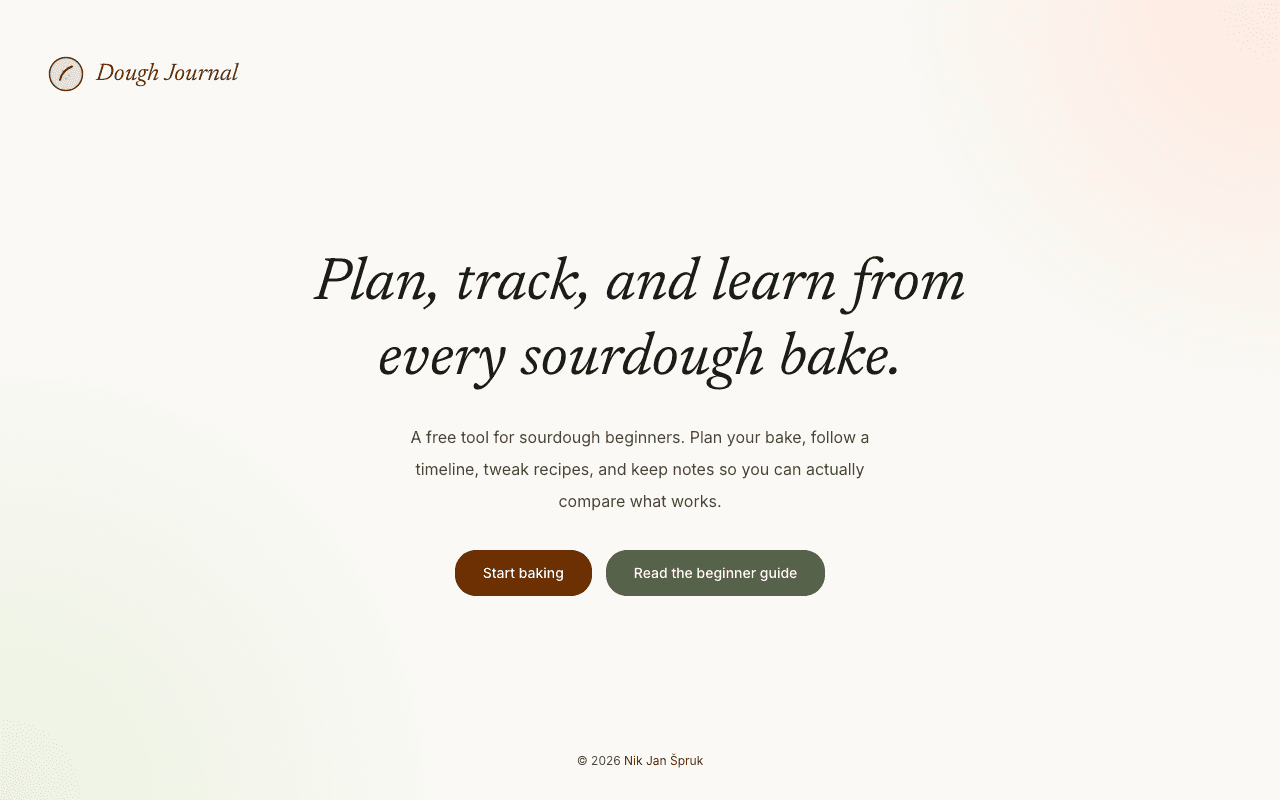
Goal
Become the go-to starting point for new sourdough bakers, helping them get through their first successful bake with less confusion.
Background
I started baking sourdough at the start of 2026. The process itself is not complicated, but the information around it is scattered. Different tutorials give different timelines. Reddit threads disagree on hydration ratios. Most guides skip the reasoning behind each step.
Then two colleagues started baking sourdough and asked me the same questions. That was the moment I realized this was not just a problem I was facing.
Resources existed, but they were scattered: a video about starter feeding here, a forum post about bulk ferment timing there, a separate calculator somewhere else. Nothing guided a beginner through the full process in one place, in the right order, with clear timing.
Understanding the User
Target user
Someone completely new to sourdough, or in their first few months of baking. The product covers both groups. The glossary, starter care guide, and first bake walkthrough help the total beginner. The timeline, tracker, and journal are built for someone who already has a starter and wants to bake regularly. These users are motivated and have already watched videos and joined online communities. The problem is not a lack of effort. The information they find is inconsistent, and none of it helps them plan their day around a bake.
What I observed in sourdough communities
Before building, I browsed sourdough communities to see what people were asking. The pattern was clear: starter health questions, confusion about bulk fermentation timing, and uncertainty about when the dough was ready to shape and bake. Nobody was asking for more recipes. They were asking for clearer guidance on the process.
This was informal research, not structured interviews. The two colleagues who started baking at the same time confirmed that the problem was not unique to me. The wider user base has not yet been formally studied.
Core pain points
- No reliable way to know when each step should happen relative to the others
- Baker's percentages are confusing and manual to calculate
- No way to track a bake in progress. Apps like Sourdough Home focus on starter tracking and recipe apps like Tartine focus on ingredient ratios, but none guide you through an active bake step by step
- No way to compare bakes and understand what changed between them. No sourdough app offers a structured journal with side-by-side comparison
Solution Exploration
Notion / Google Sheets
RejectedFast to produce and easy to build. No code required. The problem is that a spreadsheet cannot be interactive. It cannot update a bake schedule from a real start time, run a live percentage calculator, or track an active bake in progress. Sharing is also awkward. Every user would need to copy the template themselves, and there would be no central place to push improvements to all users at once.
Blog post or PDF guide
RejectedEven simpler and good for SEO. Same core limitation: purely static. A guide can tell you what to do but cannot respond to when you are actually starting your bake or calculate your specific ingredient quantities.
Web app
ChosenMore effort upfront, but the core problems required interactivity. The timeline only works if it calculates from a real start time. The calculator only works if it updates as you adjust sliders. The journal only works if it saves across sessions. A web app was the only format that could do all three, scale to many users without additional effort, and be monetized over time.
What I Built
Built in priority order. Each feature solves a specific user problem.
Bake timeline
Built firstThe immediate problem that prompted the project: I needed to know when to feed my starter so the bake would finish at a time that fit my day. You enter your start time and get a full schedule from starter feed through baking. This removes the most stressful part of sourdough for beginners.
Baker's percentage calculator
Sourdough recipes are written as ratios relative to flour weight. Beginners do not know this and converting manually is easy to get wrong. The calculator uses sliders with set ranges: 40% hydration produces unusable dry dough, 150% produces soup. Sliders make the acceptable range clear without any explanation and update gram amounts in real time as you drag.
Onboarding content
Three free resources with no login required: a first bake walkthrough, a starter care guide, and a glossary. These exist because the timeline and calculator assume some basic knowledge. Without them, a total beginner would still get stuck on terms like bulk ferment or crumb.
Active bake tracker
Once a bake starts, the tracker shows your current step and what comes next. Stretch and fold reminders are built in so you do not have to keep a mental count across two to four hours of bulk fermentation.
Bake journal and comparison
Built lastEach entry stores ingredient quantities, a photo, and notes. The comparison view lets you pick two bakes from a dropdown and see them side by side with color-coded highlights on what changed. Built last because it is only useful after you have at least two bakes to compare. It is a feature for the baker who is improving, not for the total beginner.
Out of scope for v1
Social features, community recipes, nutrition tracking, anything requiring real-time collaboration. The goal was to solve the timing and tracking problem for a solo baker, nothing more.
Monetization
The core tools (timeline, calculator, guides, glossary) are free with no login. A login is required only to save bakes and use the journal, because that data needs to be stored in a database.
Everything is free right now. Server and database costs are low at this stage, and putting a paywall in front of a beginner who is just trying to learn feels wrong. The plan is a freemium model: a limited number of saved journal entries for free, and unlimited entries on a paid tier. The core experience stays free to keep the product accessible. Revenue comes from users who bake regularly and get enough value from the journal to pay for more of it.
Risks and Tradeoffs
No distribution plan yet
The product has about five users. Without active distribution (Reddit, social, SEO), usage will not grow on its own. This is the most immediate risk and has nothing to do with the product itself.
Small validation sample
The problem was validated through personal experience and two colleagues, a sample of three. The Reddit research was informal. There is a real chance that what was built reflects one person's workflow rather than the workflow most beginners actually need.
Web-first creates a notification problem
Sourdough is a timed process that takes several hours. Reminders are a natural feature. But browsers close, and push notifications on the web (especially on iOS) are limited. Choosing web first deferred this problem. Solving it will likely require email reminders or eventually a native app.
Freemium timing risk
Introducing a paid tier too early, before there is a meaningful free user base, risks hurting growth for minimal revenue. The current approach (free until costs justify a tier) is reasonable but needs a clearer trigger point.
Measurement and Iteration
If-then scenarios
If
If week-4 retention is low
Then
The tool is either not useful enough after the first bake or the target user bakes infrequently. Next step: user interviews to find out which.
If
If journal adoption is low among logged-in users
Then
The feature may create too much friction or may not be visible enough. A/B test a simpler quick-log flow.
If
If calculator is the most-used feature but timeline retention is low
Then
Explore a standalone calculator as a shareable link optimised for SEO.
Planned next steps
- 1.Distribution: post to sourdough communities, write an SEO-targeted beginner guide that links to the app
- 2.Notifications: email-based reminders as the lowest-friction solution for a web app
- 3.Images and video for stretch and fold steps — written instructions for a tactile skill have limits
- 4.Journal refinement once there is real usage data on how people actually compare bakes
Reflection
The product does what it was designed to do. The decision I would revisit is the platform choice. Choosing a web app over a mobile app made sense for speed of development, but it created the notification problem I now have to solve. Sourdough baking is a multi-hour process and a timed reminder is not optional. If I were starting over, I would either build a progressive web app with push notification support from the beginning, or plan the email integration before launch rather than leaving it for later.